For industrial contractors, construction project information only creates value when it supports sales execution. Knowing which projects exist is helpful. Connecting those projects to service lines, opportunities, and revenue is what allows teams to work with greater clarity and consistency.
That challenge is common for organizations operating across multiple business units and entities, especially when project information lives in spreadsheets or disconnected systems.
To address this, one industrial contractor integrated Industrial Information Resources (IIR) construction projects directly into Salesforce.
The starting point
Before the integration, project information was fragmented. Teams relied on spreadsheets and manual tracking, making it difficult to connect construction projects to opportunities or understand performance across service lines.
By bringing IIR construction projects into Salesforce, the organization created a single system where projects could be reviewed, qualified, and worked through the sales process.
The goal was not simply to import project records, but to ensure those projects supported daily sales activity inside Salesforce.
Configuring Salesforce to match the business
Rather than forcing teams to adopt generic configurations, Salesforce was configured to reflect how the organization already operates.
Construction stages were mapped to the phases the business uses internally, including engineering, construction, and maintenance. This allowed users to quickly understand project status without translating between systems.
Building type and subtype values were also customized. While standardized values are often used to support multiple construction databases, this team preferred the exact terminology used in IIR. Those values were mapped directly into Salesforce so users saw familiar language throughout the platform.
Creating opportunities from construction projects
Once projects were available in Salesforce, the next step was turning them into opportunities in a consistent way.
Opportunities are created directly from construction projects using a guided screen flow. This flow captures key information such as business entity, business unit, service line, opportunity owner, bid date, and close date. By guiding users through these steps, opportunity creation remains consistent across teams and regions.
Each opportunity represents a specific service line tied back to the original construction project. This structure allows the organization to track performance by service line while maintaining a clear connection to the underlying project.
To support this model, the team also requested the ability to clone opportunities. Instead of returning to the construction project each time a new opportunity is needed, users can duplicate an existing opportunity and adjust only what has changed. This reduced repetitive work and helped maintain consistency across opportunities.
Reporting that supports daily sales activity
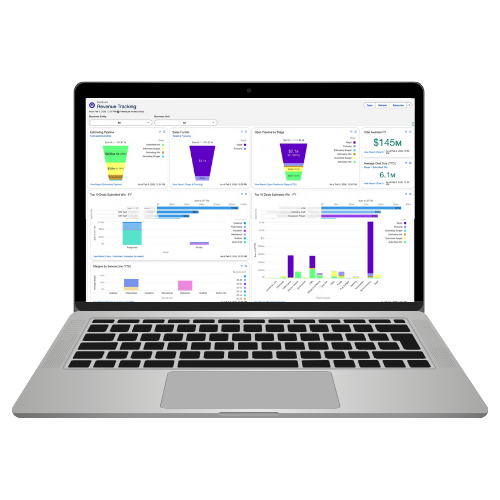
Reporting and dashboards play a central role in how this team uses Salesforce.
Opportunities are reviewed by service line and industry, giving sales teams and leadership visibility into how different parts of the business are performing.
Report-based views were created to mirror commonly used list views. These reports are reviewed regularly to understand what has been submitted, what remains open, and what is moving forward. What previously required spreadsheet preparation is now handled directly in Salesforce.
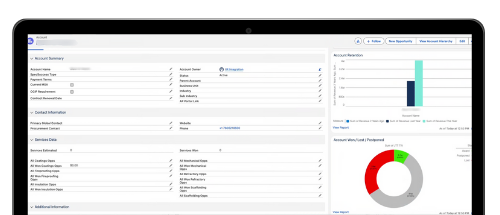
At the account level, additional reports compare performance year over year and show win and loss trends by customer. This allows teams to evaluate account performance without leaving Salesforce.
Why this matters
This integration went beyond bringing construction project data into Salesforce. It supported a shift toward using Salesforce as the primary system for managing opportunities and reviewing performance.
By aligning Salesforce with existing business structure and investing in reporting that reflects how teams work, the organization built a foundation that supports consistent sales execution across service lines.
For industrial contractors evaluating IIR integrations, this approach shows how construction project information can become part of everyday work in Salesforce rather than a separate reference point.