Getting More Visibility from BuildingConnected with Salesforce
BuildingConnected is great at what it was designed to do: help subcontractors respond quickly when GCs send bid invites. But when your sales motion lives entirely inside a bid portal, it’s hard to scale – it’s just not a CRM. You end up with tabs everywhere, unclear ownership, inconsistent qualifying, and constant “Where are we on this?” conversations.
The real issue isn’t the tool, it’s the disconnect
When BuildingConnected, or other ITB sources, are your only source of truth, you’re missing the pieces that actually help a team grow:
- A clean view of the pipeline
- Account history (what you bid, won, lost, and why)
- Reliable dashboards for forecasting and weekly execution
- Data hygiene that holds up over time
Salesforce is built for long-term relationship management and pipeline visibility. BuildingConnected is built for bid activity. When those worlds connect, you get the best of both, without forcing your team to work in two places.
What “connected” looks like in practice
A strong BuildingConnected integration isn’t just dumping data into Salesforce. It’s pulling the right information at the right time so sales teams can qualify, pursue, and track work with confidence.
1) Cleaner pipeline management
Instead of living in bid invites and spreadsheets, teams get a structured view of active projects, due dates, and status. That makes it easier to answer questions quickly:
- What’s due soon?
- What’s overdue?
- What’s worth pursuing?
- What changed since last week?
That clarity is hard to maintain when everything stays trapped in a bid board.
2) Better visibility into the accounts that matter
Once projects and opportunities are connected correctly to accounts, Salesforce becomes a relationship engine, especially for teams working regionally with a concentrated set of GCs. You can see:
- How often you’re bidding with key GCs
- What’s active right now
- Win/loss trends over time
- Where repeatable revenue is really coming from
3) Dashboards that support real weekly execution 
With the right data in Salesforce, leadership and reps can align around dashboards that actually reflect how the business runs, things like:
- upcoming bid dates and past-due bids
- upcoming project start dates
- segmentation by project size/priority
- win/loss and pipeline performance
Automation that keeps reps focused
One of the smartest moves is separating incoming projects from qualified opportunities.
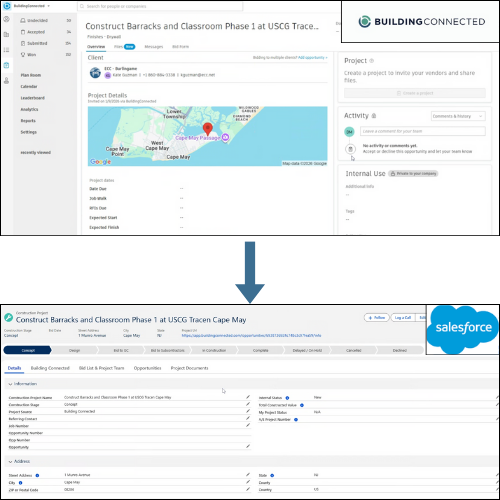
In this approach, BuildingConnected projects land in Salesforce as “construction projects.” Then, when a qualifying signal appears, like a job number, Salesforce automatically generates an Opportunity. That creates a clean workflow:
- Construction Projects: early-stage inflow (high volume, not all worth chasing)
- Opportunities: qualified work with a clear path to revenue
The result is a pipeline that stays clean.
The integration challenge most teams don’t expect: duplicate accounts & projects
Bid platforms don’t always handle identity the way a CRM needs.
For example, different GC offices (New York vs. New Jersey) can sometimes share the same underlying identifier in the source system. In Salesforce, that can lead to duplicates or merged records that shouldn’t be merged.
And what if you have other project sources? If you leverage Dodge or ConstructConnect, those sources will frequently have sourced that project for you before you ever got tapped for the bid list.
A strong integration resolves this by designing a truly unique identifier, often by combining a company ID with an office/site ID, so each office is represented cleanly. And the ability to reconcile separate project sources to a single, unified record keeps a single source of truth. That unlocks better reporting and more reliable account history over time.
If you’re bidding a lot, you need more than a bid board
Connecting BuildingConnected to Salesforce doesn’t just reduce swivel-chair work. It gives you:
- one place to manage pipeline
- real account intelligence
- dashboards leadership can trust
- automation that removes manual steps
- a foundation that scales with growth
Because eventually the question isn’t “How many bids did we get invited to?”
It’s “Are we converting the right work, and building repeatable wins?”
That’s connected selling. And it’s how teams grow without chaos.